Showing posts with label sculpture. Show all posts
Sunday, 6 October 2013
George III
This handsome devil with the big Hanoverian hooter is George III, King of Great Britain and Ireland from 1760 to 1820. I came across him in the grounds of Lincoln Castle last weekend and was surprised that no information about the bust was displayed, not even a plaque with his name.
A little research reveals that the stone bust, part of a 15ft statue of the monarch, was originally attached to the top of Dunston Pillar, south of Lincoln, in 1810, to celebrate the 50th year of George's reign.
The full-length statue was taken down in 1940 and put into storage because the RAF feared the structure could be a hazard to low-flying aircraft.Fragments of it were reassembled into a bust in 1970 and put on public display until 2007, when it was found to be cracking up and was put back into storage.
Further restoration was carried out and the bust was returned to public display in 2010. The legs and the rest of him are still in storage.
Wednesday, 19 December 2012
Foliate Head
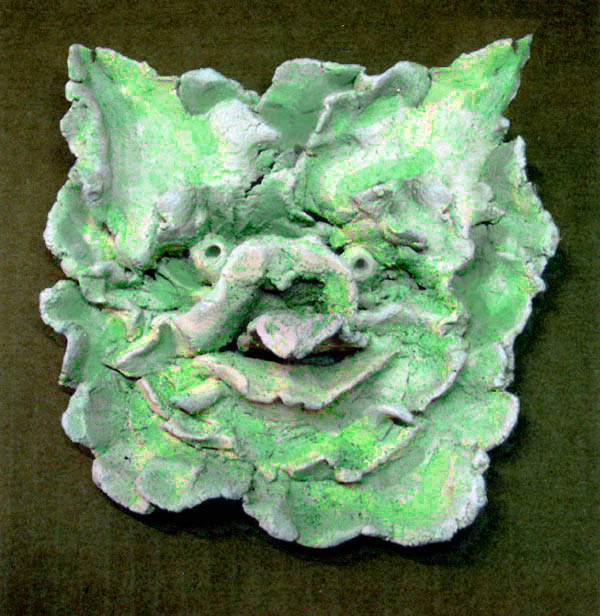
Foliate Head (Fired clay)
I've always been fascinated by the Green Man. Carvings depicting the Green Man are usually referred to as foliate heads and are common in medieval architecture, especially churches, despite the image's pagan origins.
This interest was rekindled recently when I found that foliate heads are something of an obsession with Clive Hicks-Jenkins on his Artlog and that there are one or two more on Phil Cooper's hedgecrows.
A little over twenty years ago I spent the day at Newcastle University doing a clay sculpture workshop with their sculpture technician. At the end of the day I had some clay left over and decided to make something quickly. Working quite intuitively, I found this foliate head growing under my fingers.
Unfortunately, one of the head's leafy "ears" broke off in the firing and is now, if not lost, mislaid. What you can see below is a repair using Photoshop, to give you an idea of what it ought to look like.
One day, I'll colour it. Green, of course.
Labels:
architecture,
clay,
foliate heads,
Green Man,
Newcastle University,
sculpture
Thursday, 19 November 2009
Maquette


The maquette is inaccessible, I'm afraid, but here are two photos, touched up with some wobbly Photoshoppery, which give some idea of how it looks.
The studio assistant with responsibility for sculpture proved her future value by saying, "You've been looking at too much sculpture, Harry." Suitably encouraged, the following year I dropped Sculpture in favour of Painting and Printmaking.
Tuesday, 17 November 2009
Drawing for Sculpture 2

Ideas for sculpture (Two pages, A4 sketchbook)

Ideas for sculpture (Two pages, A4 sketchbook)
Some pages from my sketchbook showing work on ideas for the sculpture derived from urban drawings. The top one was based on a drawing of some fire escapes, the lower one on the drawing of part of The Swing Bridge connecting Gateshead to Newcastle, posted last time. The second drawing is more fully realised because the maquette was being made by then.
Friday, 13 November 2009
Drawing for Sculpture

High Street Fire Escape (A4 sketchbook)

Concrete Walkways (A4 sketchbook)

Swing Bridge (A4 sketchbook)
As well as the drawings on sheets of A2 paper I've been showing you, I also did a few drawings in my sketchbook.
You can see in the last one that I was starting to work on ways of adapting the drawing of the Swing Bridge for sculptural purposes. Next time I'll show how I developed these ideas further and, with luck, I may be able to find the maquette for the final sculpture.
Thursday, 15 October 2009
Old Drawings #43

Processional Way, Civic Centre (charcoal on A2 cartridge paper)
I'm full of cold at the moment and struggling to complete my end of year accounts, so only time to post another in the Old Drawings series.
This is the third of those I did for the Drawing for Sculpture project in 1997. It's a drawing of part of the Processional Way leading into Newcastle's Civic Centre and shows an ornate bronze screen which proved a bugger to draw with wind-frozen fingers.
Labels:
cartridge paper,
charcoal,
drawing,
Old Drawings,
sculpture
Sunday, 15 August 2004
The Language of Sculpture

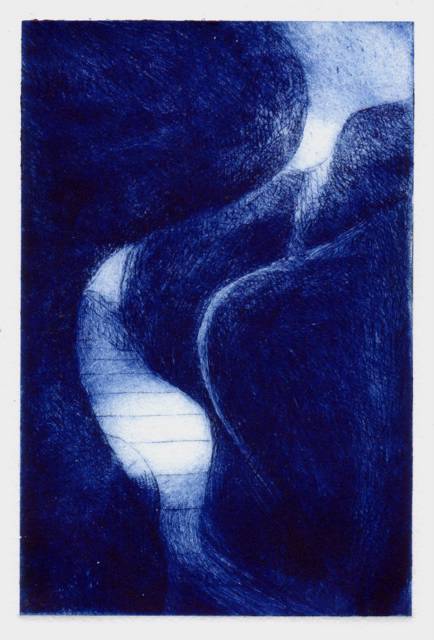
Henry Moore sculpture (etching & aquatint)

BBC4, the digital channel, have been running a truly excellent series of programmes about the Sixties and I became conscious last night that I'd not kept up to date with all of them.
They showed what I understood to be the second part of a three parter called Art and the 60s, and it was fascinating. It dealt with the radical changes in British sculpture which came about mainly through the work being done at St Martin's School of Art.
The programme led off with Anthony Caro's rebellion against the naturalism of his mentor, Henry Moore (he worked as Moore's assistant for two years). Destroying all he'd done in the Moore manner, he went on to devise a purely abstract form of sculpture made from flat aluminium rectangles, beams and rods, all painted a vivid colour
In this respect, it was interesting to hear him say that his very first sculpture in this new style was painted green. His wife told him it didn't work and suggested he paint it red, which he did.
I've never been a great lover of Caro's work, although some of his more recent work which I saw at Tate Modern a few years ago (such as Child's Tower Room), did seem to have something about it. There's no denying, however, that he set the scene for a break with sculpture of the past while providing a set of rules and guidelines (codified in print by William Tucker) to take things forward.
And following closely behind Caro was Phillip King.
King also spent a couple of years working with Moore and also came to reject his way of working. He embraced Caro's new sculptural guidelines and using new materials, such as fibreglass, produced strange, colourful sculptures derived almost entirely from his imagination, like Rosebud and Genghis Khan.. Long before I ever grew interested in fine art, I loved the work of Phillip King.
Indeed, the Sixties are where I began to be both fascinated by fine art and disillusioned by the direction it seemed to be taking. Because no sooner had Caro laid out his rules for making sculpture, then, of course, a new generation came along who saw it as their duty to throw out, or at least question those rules.
As the programme demonstrated, it was a short slippery slope through the performances of Bruce McLean, the recorded walks of Richard Long, Barry Flanagan's heap of sand with the middle scooped out, to the music hall posturing of Gilbert & George's Singing Sculpture..
My use of the term "slippery slope" I freely admit puts a slant on the programme which the producers perhaps would not want. But they were able to draw out of some of the older artists a view that much of the later work was "not sculpture."
And personally, I was fascinated by the fact that while Caro and King were prepared to talk openly about their ideas, people like Long and Flanagan were at first unwilling even to be interviewed and then either aggressive or monosyllabic in their replies to perfectly reasonable questions.
Subscribe to:
Posts (Atom)