"Went to the library."
My love of books and reading came from my Dad.
Showing posts with label books. Show all posts
Showing posts with label books. Show all posts
Tuesday, 3 January 2017


Monday, 27 August 2012
Very First Sketchbook (#8)

In the Moat, Rhodes, 17.9.86
(Fine point marker and grey Magic marker in A5 sketchbook)
Before leaving on this trip, I'd been reading Drawing with Markers by Richard Welling. As a result, when I went into the moat again, this time I was armed with a grey felt tip in addition to my fine point. I was quite pleased with the result at the time and I continued to use this combination, off and on, for some time to come.
Monday, 9 January 2012
Edward Burra

To be accurate, he didn't knock this morning. He rang the doorbell.
As I struggled into my dressing gown and rushed downstairs, I ignored the cries from Pat of "There is no bug! The doorbell didn't ring! Don't go outside with no clothes on!" I leave you to decide which of us was the more awake.
I admit I 'm prone to hearing phantom doorbells which have more or less replaced the catalogue of nightmares I've listed before, but this time I knew there was a book on it's way from Amazon and I was anxious to avoid having to go to the depot to collect it tomorrow.
The book in question was the volume published by Palant House in connection with their exhibition of Edward Burra's work. Although my interests in painting extend well beyond these shores, I have an abiding fascination for the work of British painters of the 20th century, and there was a distinct gap in my knowledge of Burra.
Never in good health, he chose to work mainly in watercolour on a large scale and the book captures the remarkably vivid colours he was able to achieve with his chosen medium by constantly overlaying with thicker and thicker paint. I was familiar with the paintings of bars and Harlem low-life (see the cover above) and the Surrealist tendencies (he was a friend of Paul Nash and showed with the Englsih Surrealists in the 1930s) but the landscapes were a real revelation in their pared down simplicity.

Valley and River, Northumberland, 1972
(Pencil and watercolour on paper, 40 x 27 ins)
A lovely book. I'd love to have seen the exhibition.
Saturday, 4 October 2008
Golden Stud
In 1997 I had my left earlobe pierced. It was shortly after I left work for university and people assumed it was because I was going to uni and wanted to blend in. Had that been the case, I'd have been sorely disappointed, because by the time I started there, the fashion had moved on and no one had their earlobe pierced. Top of the ear yes; nose yes; eyebrow yes; tongue yes; body parts I don't want to think about yes; earlobe? No way.
No, my actual reason was symbolic, but with a nod to my curious childhood admiration for the drop pearl ear-ring worn by Errol Flynn in The Private Lives of Elizabeth and Essex (1939). The Earl of Essex beard arrived the following year, but instead of Errol Flynn, it made me look like Eddie Izzard, and along with many other things, it went in 2002.
The symbolic gesture was rather simple, and as such would qualify for inclusion in many a Conceptual Art exhibition - I had my ear pierced then because I would never have done so while at work because I felt it would have hampered my chances of promotion. Having it done now was a personal sign that I was most certainly never ever going back to work for The Man.
Since then, I've grown used to having the gold stud in my ear. It was the stud they gave me in the jewellers when they did the piercing and it was always comfortable. The only time I took it out was to put something a little fancier in - a ring, or a Murano glass stud, or a key pattern from Crete.
On the way back from Mallorca I realised it was no longer there. I guess it must have been rubbed out when I was sleepily drying off after a shower before catching the pre-dawn bus to Palma. Since then, I've felt strangely ill at ease.
Many of you will be familiar with the shaggy dog story about the boy who was born with a golden screw in his navel. Even Thomas Pynchon includes it in Gravity's Rainbow, I understand. Over countless pub tables I've listened to various accounts of how the boy ventures forth into the world to find out how to remove the screw. To cut a very long story short, he does of course find someone who can provide him with a golden screwdriver with which to unscrew his golden screw. And when he does, his bottom falls off.
OK, it's a silly story and whether the punchline is worth waiting for is dependent on how well the storyteller does his business. But I'm beginning to feel a vague sense of kinship with the boy with the golden screw in his navel in that since I got back from Mallorca, I've been feeling cut loose, disconnected, at a loose end, unsettled.
Finding the Virgin Media set-top box didn't work when I got home didn't help. I admit to watching too much tv, but not being able to watch any at all was a real bummer. But a bummer with it's occasional rewards. For something to watch - I really am a very visual person and need regular visual input - I dug out loads of old videos and caught up with things I'd recorded years ago and never watched. Babette's Feast was well worth catching up with and I found an old BBC programme about drawing in which the excellent David Gentleman does a drawing of the river near the gasometers at King's Cross. Working quickly and intuitively in fountain India ink and washes of watercolour, he made me feel so clumsy. Eventually, I was reduced to watching episodes of Clangers, with Noggin the Nog held in reserve.
The tv is working again, and I see there's the same old rubbish on, so I'm trying to work my way into an investigation of some of the new subjects I discovered on Mallorca, but it seems like heavy going. Nothing I do is working and most of it isn't salvageable. In all probability, I'm simply in a period between the end of all the work for this year's shows and whatever I will be doing next - what Eric Maisel , in his book, The Van Gogh Blues, calls a Meaning Respite.
But were I more superstitious (more? I'm not superstitious at all!) I'd think that removing the golden stud from my ear has caused the bottom to drop out of my world.
No, my actual reason was symbolic, but with a nod to my curious childhood admiration for the drop pearl ear-ring worn by Errol Flynn in The Private Lives of Elizabeth and Essex (1939). The Earl of Essex beard arrived the following year, but instead of Errol Flynn, it made me look like Eddie Izzard, and along with many other things, it went in 2002.
The symbolic gesture was rather simple, and as such would qualify for inclusion in many a Conceptual Art exhibition - I had my ear pierced then because I would never have done so while at work because I felt it would have hampered my chances of promotion. Having it done now was a personal sign that I was most certainly never ever going back to work for The Man.
Since then, I've grown used to having the gold stud in my ear. It was the stud they gave me in the jewellers when they did the piercing and it was always comfortable. The only time I took it out was to put something a little fancier in - a ring, or a Murano glass stud, or a key pattern from Crete.
On the way back from Mallorca I realised it was no longer there. I guess it must have been rubbed out when I was sleepily drying off after a shower before catching the pre-dawn bus to Palma. Since then, I've felt strangely ill at ease.
Many of you will be familiar with the shaggy dog story about the boy who was born with a golden screw in his navel. Even Thomas Pynchon includes it in Gravity's Rainbow, I understand. Over countless pub tables I've listened to various accounts of how the boy ventures forth into the world to find out how to remove the screw. To cut a very long story short, he does of course find someone who can provide him with a golden screwdriver with which to unscrew his golden screw. And when he does, his bottom falls off.
OK, it's a silly story and whether the punchline is worth waiting for is dependent on how well the storyteller does his business. But I'm beginning to feel a vague sense of kinship with the boy with the golden screw in his navel in that since I got back from Mallorca, I've been feeling cut loose, disconnected, at a loose end, unsettled.
Finding the Virgin Media set-top box didn't work when I got home didn't help. I admit to watching too much tv, but not being able to watch any at all was a real bummer. But a bummer with it's occasional rewards. For something to watch - I really am a very visual person and need regular visual input - I dug out loads of old videos and caught up with things I'd recorded years ago and never watched. Babette's Feast was well worth catching up with and I found an old BBC programme about drawing in which the excellent David Gentleman does a drawing of the river near the gasometers at King's Cross. Working quickly and intuitively in fountain India ink and washes of watercolour, he made me feel so clumsy. Eventually, I was reduced to watching episodes of Clangers, with Noggin the Nog held in reserve.
The tv is working again, and I see there's the same old rubbish on, so I'm trying to work my way into an investigation of some of the new subjects I discovered on Mallorca, but it seems like heavy going. Nothing I do is working and most of it isn't salvageable. In all probability, I'm simply in a period between the end of all the work for this year's shows and whatever I will be doing next - what Eric Maisel , in his book, The Van Gogh Blues, calls a Meaning Respite.
But were I more superstitious (more? I'm not superstitious at all!) I'd think that removing the golden stud from my ear has caused the bottom to drop out of my world.
Friday, 12 October 2007
Alfred C. Chadbourn
Most of the good artists I know review their work in their studios at least once a year, to assess the direction of their work and, more important, to find out something about themselves. In my own case, because I tend to be a bit hard on myself, I call this "reviewing the failures." It's at this time that I decide which paintings will go to the dump, which will stay with me for further work, and which will go to the gallery.
With the work strung out along the walls of my studio, I ask myself some tough questions: Is there a thread running through the work that suggests a new or different direction? What seem to be my strengths and weaknesses? Am I relying too much on one set of color possibilities? How could I stretch the color further? Have just about run out of steam on one particular subject? Or could I find something new and challenging by approaching it from another point of view Are there any really blatant influences that have crept into the work without my acknowledging it? These are some of the questions you, too, should start asking yourself to develop your own critical eye.
PAINTING WITH A FRESH EYE - Alfred C. Chadbourn N.A.
Most of the painters I know collect "How to" books, despite their almost certain expectation that the one thing the books will not tell them is "How to." I have a good collection of them, and they stay on the shelves, not because their advice is much use, but because I Like Looking at the Pictures, and sometimes the choice of palette is interesting or maybe there's a bon mot or two.
Despite this cynical view of instructional books, a select few remain as longtime favourites. And one especially has been such a favourite that when I came across another very cheap remaindered copy, I bought it to keep in the studio while I was at University.
The book is "Painting With a Fresh Eye" by Alfred "Chip" Chadbourn (Watson-Guptill, 1987). Sadly, I see it's now out of print and a bit of Googling shows that Chadbourn himself died in 1998. Pity, I think I'd like to have met him.
He seems to have been an interesting character. Born in Izmir in Turkey in 1921, he went to art school in Southern California, where he found the local art collections parochial and dull. Taking a freighter to Europe in 1947, he settled in Paris and opened himself up to the lessons of painters like Braque, Picasso, Matisse and particularly Bonnard, who had died that year.
When he returned to live in New York in 1952, he found that his new way of painting suddenly seemed stale because the Abstract Expressionists were in the ascendancy. He hung out with some of them and began to paint in a similar manner. After a year, he threw most of it away and realised the importance of being true to oneself.
I don't think Chadbourn was a great painter, but his work is fresh and direct, with an exciting use of colour and I certainly wouldn't turn my nose up at hanging one of his pictures on my wall.
Most of all, though, he seems to have been a remarkably adept tutor, judging by his books (there's one other - A Direct Approach to Painting, North Light 1980). His advice is sensible, straightforward and mercifully free from waffle. He's not averse to dropping the occasional name, but when they're of the calibre of Braque, Matisse, Hopper, Diebenkorn and Thiebaud, who's going to mind?
All of which is by way of getting to the quote at the beginning of this post. Although I've often decided that a painting simply wasn't going to work and have painted something new on top of it, I've never thought of taking stock the way Chadbourn proposes. After almost 20 years of painting, I'm beginning to accumulate an awful lot of pictures. And these take up a lot of room. It comes hard to say, "This painting is well painted, but it's simply not good enough to hang with some of the others." There's always the feeling that someone with blunted sensibilities will come along and like it more than they really should. But if I don't think it's good enough, it's not very moral of me to sell it to them, is it?
Very soon now, I'm going to take some time out to sift through my back catalogue and either destroy the poor ones or, at least, set them aside to be painted over. And I imagine I'm going to find that quite a cathartic experience.
Saturday, 7 April 2007
Rearranging the Deckchairs
After the session at the Art Club, I took a wander into town.
On a whim I strolled into J G Windows in the Central Arcade. There's always something of interest in Windows. They have a policy of buying one copy of every CD released in the UK. Naturally enough, they don't manage to sell them all, so it can be a profitable exercise to call in to check if they're having a sale.
Shock horror! The firm have been taken over and the store is being "rearranged."
The first and most obvious rearrangement is the absence of the the huge and chaotic CD racks behind the counter where they filed the discs to put into the cases when you went to buy. All replaced by an alcove with some DVDs and a fire-damaged piano.
Most deplorable of all, however, is the total absence of the helpful staff. In both the Jazz and the Classical sections, there were people who Knew Their Stuff. If they couldn't help you from their own personal knowledge, they had piles of catalogues and would spare no effort to find and order whatever it was you were looking for.
Now? There's a girl with a till. She can, however, "tell you where the jazz section is ..."
I walked off under a cloud. And found myself climbing the stairs up to the art section of Waterstones. Ever since Waterstones took over the Dillons chain, Newcastle has had the daft situation of two Waterstones stores staring at one another across the area round Grey's Monument. It might have seemed a sensible solution to rationalise the content of the two shops, putting some departments in one, the rest in another. But no, we have two bookshops with more or less the same stock. I was climbing the stairs in the one that used to be Dillons.
When I got to the Art section, there was a rather hassled-looking girl flinging books onto shelves with reckless abandon, oblivious to the few punters who stood about trying to see what she was putting on the shelves.
I went to the Poetry section and read some Simon Armitage until she was done with her rearrangement.
And what wonders had she wrought? Much of the stock - never very interesting, but sometimes containing a little neglected gem someone had thought to order in - had been whittled down and then padded out with Taschen books in their many sizes.
In what way is a bookshop fulfilling its function by putting seven copies of Taschen's Gauguin on a shelf, leaving the rest empty space?
I read recently that Waterstones is to close 34 of its stores round the country (this, after winning a contentious bid to take over the liked and respected Ottakers chain). In the rest of their shops they intend to concentrate on the more popular titles like celebrity biographies, cookery and so on.
Are these people absolutely mad?
It seems to me that Windows and Waterstones are set on demonstrating their complete misunderstanding of the modern market. Sales of books and records are falling off in the High Street because people are learning more and more the ease and lower costs involved in buying online. Where actual book and record stores can compete is in catering to the niche shopper. The person who likes to go to a shop and find unexpected treasures, things they wouldn't have known they were looking for, or couldn't find easily online.
With two major record stores (HMV, Virgin) and music departments in WHSmith and Woolworths all vying for custom, I think Windows are likely to go down the tubes and I'd be surprised if at least one of the Waterstones doesn't follow suit.
And the cultural life of Newcastle will only be the poorer.
On a whim I strolled into J G Windows in the Central Arcade. There's always something of interest in Windows. They have a policy of buying one copy of every CD released in the UK. Naturally enough, they don't manage to sell them all, so it can be a profitable exercise to call in to check if they're having a sale.
Shock horror! The firm have been taken over and the store is being "rearranged."
The first and most obvious rearrangement is the absence of the the huge and chaotic CD racks behind the counter where they filed the discs to put into the cases when you went to buy. All replaced by an alcove with some DVDs and a fire-damaged piano.
Most deplorable of all, however, is the total absence of the helpful staff. In both the Jazz and the Classical sections, there were people who Knew Their Stuff. If they couldn't help you from their own personal knowledge, they had piles of catalogues and would spare no effort to find and order whatever it was you were looking for.
Now? There's a girl with a till. She can, however, "tell you where the jazz section is ..."
I walked off under a cloud. And found myself climbing the stairs up to the art section of Waterstones. Ever since Waterstones took over the Dillons chain, Newcastle has had the daft situation of two Waterstones stores staring at one another across the area round Grey's Monument. It might have seemed a sensible solution to rationalise the content of the two shops, putting some departments in one, the rest in another. But no, we have two bookshops with more or less the same stock. I was climbing the stairs in the one that used to be Dillons.
When I got to the Art section, there was a rather hassled-looking girl flinging books onto shelves with reckless abandon, oblivious to the few punters who stood about trying to see what she was putting on the shelves.
I went to the Poetry section and read some Simon Armitage until she was done with her rearrangement.
And what wonders had she wrought? Much of the stock - never very interesting, but sometimes containing a little neglected gem someone had thought to order in - had been whittled down and then padded out with Taschen books in their many sizes.
In what way is a bookshop fulfilling its function by putting seven copies of Taschen's Gauguin on a shelf, leaving the rest empty space?
I read recently that Waterstones is to close 34 of its stores round the country (this, after winning a contentious bid to take over the liked and respected Ottakers chain). In the rest of their shops they intend to concentrate on the more popular titles like celebrity biographies, cookery and so on.
Are these people absolutely mad?
It seems to me that Windows and Waterstones are set on demonstrating their complete misunderstanding of the modern market. Sales of books and records are falling off in the High Street because people are learning more and more the ease and lower costs involved in buying online. Where actual book and record stores can compete is in catering to the niche shopper. The person who likes to go to a shop and find unexpected treasures, things they wouldn't have known they were looking for, or couldn't find easily online.
With two major record stores (HMV, Virgin) and music departments in WHSmith and Woolworths all vying for custom, I think Windows are likely to go down the tubes and I'd be surprised if at least one of the Waterstones doesn't follow suit.
And the cultural life of Newcastle will only be the poorer.
Wednesday, 25 October 2006
Red & Green
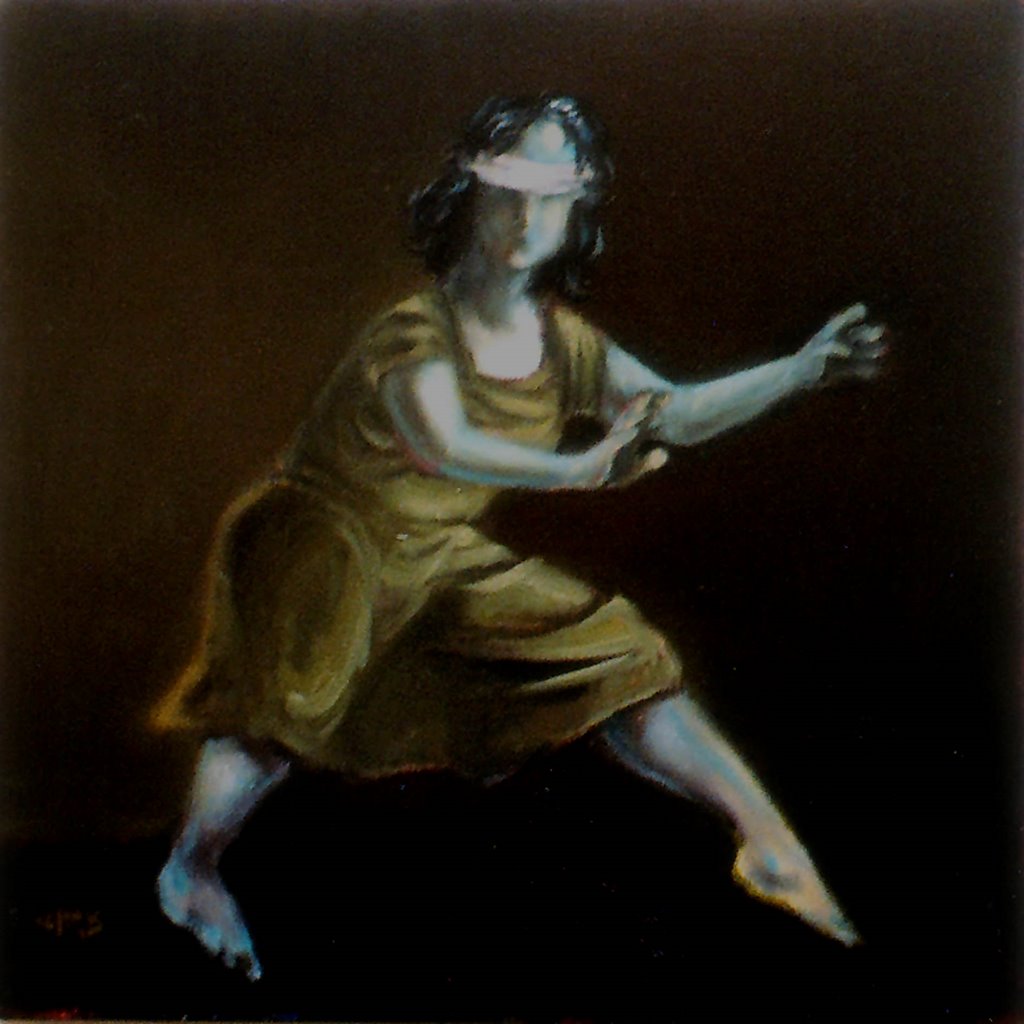
The Blindfold (oil on canvas, 16 x 16 ins)
[ An experimental painting with a tenuous link to the post. It was actually inspired by Siri Hustvedt's novel of the same name.]
In several comments on other blogs recently, I've mentioned the fact that I'm colour-blind. Specifically, my perception is deficient in the red-green range. Lots of people when they learn this wonder how on earth I manage to paint, but really it doesn't cause me much in the way of problems these days
For a long time I was unsure of colour and tended to limit myself to black and white drawings. It wasn't until I decided to buckle down and learn to paint, that I found all I needed was an understanding of colour-mixing. And when it came to red, I simply made a red that looked like what I could see.
There are times when I go against what I can see, however, and then I worry a little about how it might be perceived by others. I remember once deliberately using a Constable trick: I put in a spot of indian red on a traffic light in a painting to draw the eye. It didn't draw my eye particularly, but it seemed to work OK - the picture won me my first painting prize.
Reds vary, of course, and I find I can see red-orange more easily than red-violet. And when they appear in combination with green, I start to have practical problems. I don't often notice berries on trees, or poppies in fields (expect no Monets from me!) until they're pointed out to me, and even then, I'm underwhelmed by their vibrancy.
Green I dislike immensely, unless it's an earthy green like olive green. Don't like to paint with it, don't like to even wear it. I am unlikely to produce any useful pictures in the Summer countryside. Too much bloody green! Give me Autumn and Winter any day. Even better, put me down in a street in the city and I'm in painter's heaven.
For a long time I was unsure of colour and tended to limit myself to black and white drawings. It wasn't until I decided to buckle down and learn to paint, that I found all I needed was an understanding of colour-mixing. And when it came to red, I simply made a red that looked like what I could see.
There are times when I go against what I can see, however, and then I worry a little about how it might be perceived by others. I remember once deliberately using a Constable trick: I put in a spot of indian red on a traffic light in a painting to draw the eye. It didn't draw my eye particularly, but it seemed to work OK - the picture won me my first painting prize.
Reds vary, of course, and I find I can see red-orange more easily than red-violet. And when they appear in combination with green, I start to have practical problems. I don't often notice berries on trees, or poppies in fields (expect no Monets from me!) until they're pointed out to me, and even then, I'm underwhelmed by their vibrancy.
Green I dislike immensely, unless it's an earthy green like olive green. Don't like to paint with it, don't like to even wear it. I am unlikely to produce any useful pictures in the Summer countryside. Too much bloody green! Give me Autumn and Winter any day. Even better, put me down in a street in the city and I'm in painter's heaven.
Saturday, 14 October 2006
As I Walked Out
Walking and thinking. Thinking and walking. They do work together if you want them to. I'd set out with the intention of seeing where my thoughts led, and it was instructive, if not terribly unexpected.
Because it had come up the previous day, I reflected on the idea of the city and the countryside becoming interpenetrating. What started to surface was the possibility of seeing how this subject might be treated in paintings. At this point, I'd reverted to thinking in images, so I can't readily convey to you what was in my mind. It'll have to be filed away for the future. Before I can tackle that as a subject, I have to finish wrestling with the sensory input of two weeks in Venice last September. There are canals and vaporetti to be brought into existence.
It was only after I'd finished shopping in Borders and Sainsbury's that the other raft of thought drifted into view. The choice of self-help books had been almost instinctive and while I'd be the first to admit to serious tendencies to disorganisation and time mismanagement, I'd not felt previously that these were indicative of anything more deep rooted. But now I began to see that they probably are.
When I left work in 1997 to go to University, I didn't find it difficult to adapt. I simply exchanged one form of disciplined routine for another. There were times when I was lonely (my fellow students didn't share my need for discipline or routine and stayed away in droves, so that most of the time I was alone in the studio) but everything seemed to be continuing more or less as before.. I suspect now, however, that the first cracks in the foundations of my life structure began then. It was as I graduated in 2001 that the real collapse began to manifest itself. In rather quick succession a series of Bad Things happened in a period on which we do not dwell.
So here I was now, a free agent trying to make a living from painting, but with no sense of routine, no commitments to anyone or anything,other than to visit my Mother and ensure that she had everything she needed (except that I couldn't provide the one thing she needed above all else - my Father).
In September my Mother died, shortly after her 90th birthday. It wasn't unexpected and given the quality of her life I viewed it as something of a release. Until now, however, I hadn't viewed her death as the destruction of the last remaining prop in my world edifice.
But here I am now, an even freer agent whose only constants are the need to make artworks, and Patsy123 (the least demanding and more reliable of the two).
It may seem obvious that the death of my Mother should leave me in something of a state, but it's more than that. It's the death of the past; the death of all the old certainties; the death of my original support system.
So I need a new support system and a new set of routines and structures. Recognising that is the beginning. Enter the self-help books.
Because it had come up the previous day, I reflected on the idea of the city and the countryside becoming interpenetrating. What started to surface was the possibility of seeing how this subject might be treated in paintings. At this point, I'd reverted to thinking in images, so I can't readily convey to you what was in my mind. It'll have to be filed away for the future. Before I can tackle that as a subject, I have to finish wrestling with the sensory input of two weeks in Venice last September. There are canals and vaporetti to be brought into existence.
It was only after I'd finished shopping in Borders and Sainsbury's that the other raft of thought drifted into view. The choice of self-help books had been almost instinctive and while I'd be the first to admit to serious tendencies to disorganisation and time mismanagement, I'd not felt previously that these were indicative of anything more deep rooted. But now I began to see that they probably are.
When I left work in 1997 to go to University, I didn't find it difficult to adapt. I simply exchanged one form of disciplined routine for another. There were times when I was lonely (my fellow students didn't share my need for discipline or routine and stayed away in droves, so that most of the time I was alone in the studio) but everything seemed to be continuing more or less as before.. I suspect now, however, that the first cracks in the foundations of my life structure began then. It was as I graduated in 2001 that the real collapse began to manifest itself. In rather quick succession a series of Bad Things happened in a period on which we do not dwell.
So here I was now, a free agent trying to make a living from painting, but with no sense of routine, no commitments to anyone or anything,other than to visit my Mother and ensure that she had everything she needed (except that I couldn't provide the one thing she needed above all else - my Father).
In September my Mother died, shortly after her 90th birthday. It wasn't unexpected and given the quality of her life I viewed it as something of a release. Until now, however, I hadn't viewed her death as the destruction of the last remaining prop in my world edifice.
But here I am now, an even freer agent whose only constants are the need to make artworks, and Patsy123 (the least demanding and more reliable of the two).
It may seem obvious that the death of my Mother should leave me in something of a state, but it's more than that. It's the death of the past; the death of all the old certainties; the death of my original support system.
So I need a new support system and a new set of routines and structures. Recognising that is the beginning. Enter the self-help books.
Friday, 13 October 2006
Not so Down in the Valley
"You should get out more." Everybody says it, though mostly in a Postmodern, ironic sort of way. I say it myself, but rarely to myself. Anatole France said, "If fifty million people say a foolish thing, it is still a foolish thing," which is worth a moment's consideration; but more to the point, he also said, "It is good to collect things, but it is better to go on walks."
I decided to test his theory today and set out for the Valley once again. The sun was shining, the birds were singing, and it was a beautiful day.....
Trudging back from the Valley in the dark some four hours later, I felt I was able to consider the project in an even-handed way. Even-handed, because in my left I carried a bag of books from Borders; in my right, a bag of groceries from Sainsbury's. In my mind I carried thoughts from the walk, and as anyone will tell you, they were the most valuable of all. If they don't tell you that, you should thrash them soundly until they admit it is so.
What were the books? Books to change my life. Books to put me on the path to order, success and happiness. Nut books, in the words of my friend Doctor Pam (who swears by them) But not your run-of-the-mill everyday nut books like,Men are From Mars but Women Moved my Cheese. I sat at the table used by the man who'd committed to memory the Illustrated Karma Sutra on the previous day - though I was careful to sit in a different chair - and looked through a bundle of potentially life-changing books.
I came away with Why Am I So Disorganised? - Sort Out Your Stuff by Dr Marilyn Paul; Getting Things Done by David Allen; The Creative Habit by Twyla Tharp; and another which I shan't tell you about (and no, it isn't the Illustrated Karma Sutra) I also bought a magazine glorying in the improbable title of Turps Banana.
The David Allen book is something I just had to read. I did some research on the Interweb yesterday, finding out what I could about the books I thought I might want to buy. In the course of my research, I came across David Allen. David Allen is a phenomenon. I've never heard of him before, but try Googling his best known book Getting Things Done - or better yet, the way it's become known, GTD - and you'll find around 20,300,000 hits. It's like a religion, with the GTD acolytes vying with one another to find the best software to accommodate his "43 folder" system (which he himself advocates putting into, well, folders). Who knew so many people were in need of advice on Stress-free Productivity?
Tomorrow: what I bought at Sainsbury's. No, really...... tomorrow: what I thought about on my walk. Well you'll just have to wait, won't you?
I decided to test his theory today and set out for the Valley once again. The sun was shining, the birds were singing, and it was a beautiful day.....
Trudging back from the Valley in the dark some four hours later, I felt I was able to consider the project in an even-handed way. Even-handed, because in my left I carried a bag of books from Borders; in my right, a bag of groceries from Sainsbury's. In my mind I carried thoughts from the walk, and as anyone will tell you, they were the most valuable of all. If they don't tell you that, you should thrash them soundly until they admit it is so.
What were the books? Books to change my life. Books to put me on the path to order, success and happiness. Nut books, in the words of my friend Doctor Pam (who swears by them) But not your run-of-the-mill everyday nut books like,Men are From Mars but Women Moved my Cheese. I sat at the table used by the man who'd committed to memory the Illustrated Karma Sutra on the previous day - though I was careful to sit in a different chair - and looked through a bundle of potentially life-changing books.
I came away with Why Am I So Disorganised? - Sort Out Your Stuff by Dr Marilyn Paul; Getting Things Done by David Allen; The Creative Habit by Twyla Tharp; and another which I shan't tell you about (and no, it isn't the Illustrated Karma Sutra) I also bought a magazine glorying in the improbable title of Turps Banana.
The David Allen book is something I just had to read. I did some research on the Interweb yesterday, finding out what I could about the books I thought I might want to buy. In the course of my research, I came across David Allen. David Allen is a phenomenon. I've never heard of him before, but try Googling his best known book Getting Things Done - or better yet, the way it's become known, GTD - and you'll find around 20,300,000 hits. It's like a religion, with the GTD acolytes vying with one another to find the best software to accommodate his "43 folder" system (which he himself advocates putting into, well, folders). Who knew so many people were in need of advice on Stress-free Productivity?
Tomorrow: what I bought at Sainsbury's. No, really...... tomorrow: what I thought about on my walk. Well you'll just have to wait, won't you?
Thursday, 12 October 2006
Down in the Valley
I wonder if it's possible to write and paint? For me, I mean. I'm fully aware that there are painters who write. And there are writers who paint. There are even painters who write on their paintings. But it seems that the only time I'm visited by the writing muse is when I'm stuck with my painting.
Or when I'm in something of a depression.
Which tends to be the same thing.
I went for a walk on the Valley yesterday. As a kid, I used to love the Valley. I'd cycle there with my buddies and we'd play all day in the woods, drinking Tizer and making useless clay lamps out of the mud we'd dig up from the river bank. I don't think you can get at the river now; it's been culverted in. And there's not much left of the woods either. Cut down to make room for more offices and factory units. But that's OK really; it's what the Valley is for, and if it makes for more jobs, then who am I to complain?
I still like walking on the Valley, though. Despite there being fewer areas of woodland, there are still open fields and every Avenue is filled with trees and bushes. These are usually kept trimmed a bit, but still spill out onto the pavements. And curiously, it's pretty quiet.
A dual carriageway runs down the middle and this is always full of cars, lorries and buses rushing about their business, but the other Avenues are generally rather quiet. I suppose because everyone's at work. Except me, the lone pedestrian.
So it's a little like walking in countryside which has been invaded by the city. Or in a city which has been invaded by the countryside. I guess it's one of those curious non-places that modern civilisation tends to produce, such as airports and shopping malls, but this one is much nicer than those.
The Valley teems with wildlife. Every bush twitters with sparrows and there are innumerable blackbirds flitting silently from tree to tree, or shrieking at everyone and everything. Earlier this year (or maybe it was late last year - pleasant memories seem to flow together now into a sun-filled whole) Patsy123 and I walked on the Valley and saw a family of rabbits sitting about in the late rays of a setting sun. As we approached, they scampered off to the safety of a huge clump of overgrown shrubs by the side of their field.
But why was I on the Valley yesterday? It was a fairly miserable day, grey and misty with occasional showers, and I was somewhat grey and miserable myself. I'd decided to go there to see what Borders might have in stock (did I mention that, in addition to offices and factory units, there's also a Retail Park?) My curiosity had been piqued by mention in a recent blog of a book by Eckhart Tolle, The Power of Now. I thought it might prove interesting and/or useful.
In the event, I found I wasn't in the mood for the Tolle book, but I spent some time leafing through some other self-help books. Nowhere near as much time as the guy who slid a big illustrated copy of The Karma Sutra off the shelf and sat himself down at a table in the corner with it. He was still there when I left, slowly turning the pages. I'd like to think his wife or girlfriend might be in for a good time later that night, but somehow I doubt it.
Mostly I was fascinated by books about organisational strategies and time management which seemed to suggest a way out of my present malaise, but in the end I didn't buy anything. Maybe I'll go look again. Or maybe I'll just shake myself up and get on with things.
Or when I'm in something of a depression.
Which tends to be the same thing.
I went for a walk on the Valley yesterday. As a kid, I used to love the Valley. I'd cycle there with my buddies and we'd play all day in the woods, drinking Tizer and making useless clay lamps out of the mud we'd dig up from the river bank. I don't think you can get at the river now; it's been culverted in. And there's not much left of the woods either. Cut down to make room for more offices and factory units. But that's OK really; it's what the Valley is for, and if it makes for more jobs, then who am I to complain?
I still like walking on the Valley, though. Despite there being fewer areas of woodland, there are still open fields and every Avenue is filled with trees and bushes. These are usually kept trimmed a bit, but still spill out onto the pavements. And curiously, it's pretty quiet.
A dual carriageway runs down the middle and this is always full of cars, lorries and buses rushing about their business, but the other Avenues are generally rather quiet. I suppose because everyone's at work. Except me, the lone pedestrian.
So it's a little like walking in countryside which has been invaded by the city. Or in a city which has been invaded by the countryside. I guess it's one of those curious non-places that modern civilisation tends to produce, such as airports and shopping malls, but this one is much nicer than those.
The Valley teems with wildlife. Every bush twitters with sparrows and there are innumerable blackbirds flitting silently from tree to tree, or shrieking at everyone and everything. Earlier this year (or maybe it was late last year - pleasant memories seem to flow together now into a sun-filled whole) Patsy123 and I walked on the Valley and saw a family of rabbits sitting about in the late rays of a setting sun. As we approached, they scampered off to the safety of a huge clump of overgrown shrubs by the side of their field.
But why was I on the Valley yesterday? It was a fairly miserable day, grey and misty with occasional showers, and I was somewhat grey and miserable myself. I'd decided to go there to see what Borders might have in stock (did I mention that, in addition to offices and factory units, there's also a Retail Park?) My curiosity had been piqued by mention in a recent blog of a book by Eckhart Tolle, The Power of Now. I thought it might prove interesting and/or useful.
In the event, I found I wasn't in the mood for the Tolle book, but I spent some time leafing through some other self-help books. Nowhere near as much time as the guy who slid a big illustrated copy of The Karma Sutra off the shelf and sat himself down at a table in the corner with it. He was still there when I left, slowly turning the pages. I'd like to think his wife or girlfriend might be in for a good time later that night, but somehow I doubt it.
Mostly I was fascinated by books about organisational strategies and time management which seemed to suggest a way out of my present malaise, but in the end I didn't buy anything. Maybe I'll go look again. Or maybe I'll just shake myself up and get on with things.
Tuesday, 21 September 2004
Books Before Bedtime
Having finished Dan Brown's The Da Vinci Code, I really don't understand all the hoohah. It's not a very good book.
Oh sure, it's crammed to the gills with information, but it's so poorly written that the lumps of information sit on the page like rocks in a river, slowing the flow.
For instance, in an early part of the book, the protagonists are racing through the Tuileries in Paris. Despite the fact that the Tuileries play no part in the workings of the plot, Brown feels it important enough to stop the action and leadenly dump into his prose an explanation of the name "Tuileries".
It's like that all the way through. People suddenly find themselves, even in the most dangerous moments, being "reminded" of yet another irrelevant fact or other.
I thought at first that it was quite a page-turner, but eventually I found myself yearning for the end to come. I really need to shake off this feeling of having to finish a book, just because I've started it. Life's too short and there are more than enough good books to read.
If you want to read about the Merovingians, the Knights Templar and the conspiracies surrounding Mary Magdalene and the Jesus bloodline, look out a copy of Henry Lincoln's Holy Blood - Holy Grail.
Although not an especially good book, I got more out of an hour reading Rhino Ritz: An America Mystery by Keith Abbot, which contains the following:
A bizarre concoction written by someone I've never heard of, it's strangely reminiscent of William Kotzwinkle or more nearly, Richard Brautigan.
And whatever became of Richard Brautigan?
Apart from being dead, that is.
Oh sure, it's crammed to the gills with information, but it's so poorly written that the lumps of information sit on the page like rocks in a river, slowing the flow.
For instance, in an early part of the book, the protagonists are racing through the Tuileries in Paris. Despite the fact that the Tuileries play no part in the workings of the plot, Brown feels it important enough to stop the action and leadenly dump into his prose an explanation of the name "Tuileries".
It's like that all the way through. People suddenly find themselves, even in the most dangerous moments, being "reminded" of yet another irrelevant fact or other.
I thought at first that it was quite a page-turner, but eventually I found myself yearning for the end to come. I really need to shake off this feeling of having to finish a book, just because I've started it. Life's too short and there are more than enough good books to read.
If you want to read about the Merovingians, the Knights Templar and the conspiracies surrounding Mary Magdalene and the Jesus bloodline, look out a copy of Henry Lincoln's Holy Blood - Holy Grail.
Although not an especially good book, I got more out of an hour reading Rhino Ritz: An America Mystery by Keith Abbot, which contains the following:
F. Scott Fitzgerald was trying to put his arm back on. It had fallen off in the street and he was trying to put it back on so he could drink some more. It was his right arm and he needed his right hand to drink with.
A bizarre concoction written by someone I've never heard of, it's strangely reminiscent of William Kotzwinkle or more nearly, Richard Brautigan.
And whatever became of Richard Brautigan?
Apart from being dead, that is.
Saturday, 4 September 2004
Imitation Limestone
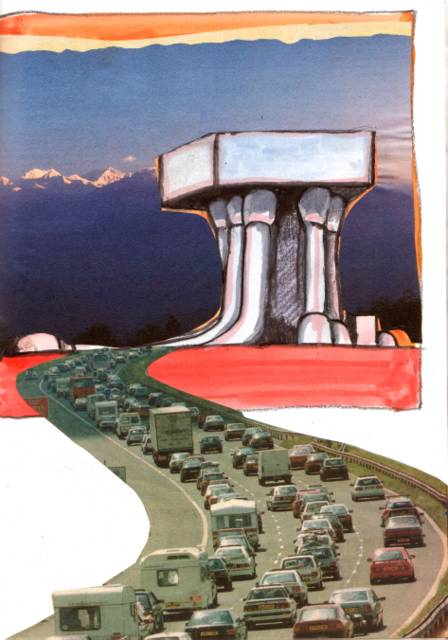
Sketchbook page (w/c, pencil & collage)

I have lots of sketchbooks. I went through a long period of collecting them. Most of them are empty, or at best only partly filled.
At University I'd buy two new ones at the beginning of each year, even if the previous ones weren't filled (which they weren't). It felt right, somehow, to divide up the periods of creativity. But I'd also buy others that seemed to offer that special size or shape for some other project I had in mind.
I like the idea of sketchbooks. I suppose that's to do with my love of books as objects. But somehow I've never got in the habit of using them regularly. I think it's because I find loose bits of paper more easily organised into projects. Maybe that's because I always seem to have an interest in several idea-threads at one time.
Curiously, having talked to other artists about this, I find I'm not alone.
In an attempt to try to get some sense into this state of affairs, I've been going through these old sketchbooks - the partially completed ones - to see if I might begin to use them again and also to see if they might conveniently continue with their respective themes (assuming they have any).
There are problems with this. One dates from a trip I made to Malta and is concerned mainly with the remnants of Tigne Barracks. I think that may have to remain discrete. There's another devoted to drawings done inside the Hancock Museum. As such, I regard that as an ongoing project, or at least one to which I'll return sometime in the future.
But the rest are somewhat haphazard, and probably the best that I can do is simply pick up one and fill it, going on to the next.
Going through them, however, has proven supremely beneficial. Tucked inside one of them, evidently marking the place, was a slip of folded paper. And on it was the legend: "Imitation Limestone."
I have found the Recipe for All-Bran Cement!
Of course, as I've long suspected, it has nothing whatsoever to do with All-Bran. But for those of you whose work may have been tottering on the brink, needing only the recipe to continue, here it is:
- 2 parts coir
- 2 parts sharp sand
- 1 part fresh cement
- cement colourant
Something of an anticlimax after all this time.
And the page it was marking? That's it at the top of the post. What was I thinking?
Thursday, 2 September 2004
O for a Muse of Fire!
I think I'm still basking in the warm glow of having nothing that must be done. My mind seems empty of anything worth putting in words.
I suspect, in fact, that this is as a consequence of having spent so much time recently thinking visually. I've got out of the habit of verbalising. Normally I find myself writing things in my head and can't wait to get them down on the screen.
All I have at the moment are images - images of streets, images of figures, images of more abstract elements derived from buildings and rust and brick and pipework.
In an attempt to reconfigure my brain, I'm reading. I recently finished Chris Petit's Robinson - a fascinating book which manages to transpose some of the qualities of Neo-Romanticism (did I mention that Graham Sutherland was the subject of my Dissertation?) from the landscape to an urban setting.
In the dark underworld of seedy London, the narrator is seduced and manipulated into Robinson's schemes. Dragged down by alcoholism and drugs, he finds himself involved, first of all, in the shady side of the second-hand book business.
But Robinson - a Harry Lime for today - continues his corruption by drawing him into pornographic film-making and finally into collusion in torture and murder.
Petit, a film-maker himself, paints an unforgettable picture of the city's underbelly, full of cardboard-box townships and riots, with an apocalyptic storm as the ultimate backdrop. JG Ballard, out of Iain Sinclair.
And now for something completely different, and certainly less demanding. I've just started Dan Brown's The Da Vinci Code., which, despite the hype, comes well recommended. I'd have preferred it to be called The Leonardo Code, though.
I suspect, in fact, that this is as a consequence of having spent so much time recently thinking visually. I've got out of the habit of verbalising. Normally I find myself writing things in my head and can't wait to get them down on the screen.
All I have at the moment are images - images of streets, images of figures, images of more abstract elements derived from buildings and rust and brick and pipework.
In an attempt to reconfigure my brain, I'm reading. I recently finished Chris Petit's Robinson - a fascinating book which manages to transpose some of the qualities of Neo-Romanticism (did I mention that Graham Sutherland was the subject of my Dissertation?) from the landscape to an urban setting.
In the dark underworld of seedy London, the narrator is seduced and manipulated into Robinson's schemes. Dragged down by alcoholism and drugs, he finds himself involved, first of all, in the shady side of the second-hand book business.
But Robinson - a Harry Lime for today - continues his corruption by drawing him into pornographic film-making and finally into collusion in torture and murder.
Petit, a film-maker himself, paints an unforgettable picture of the city's underbelly, full of cardboard-box townships and riots, with an apocalyptic storm as the ultimate backdrop. JG Ballard, out of Iain Sinclair.
And now for something completely different, and certainly less demanding. I've just started Dan Brown's The Da Vinci Code., which, despite the hype, comes well recommended. I'd have preferred it to be called The Leonardo Code, though.
Friday, 23 July 2004
A breath of sea air
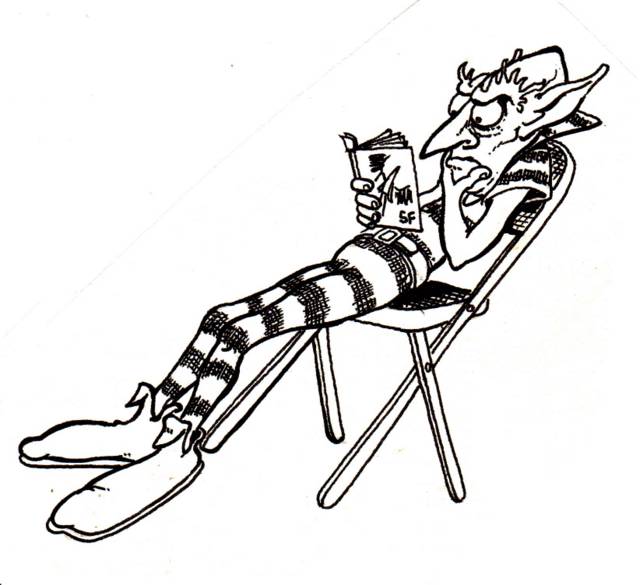
Another long afternoon in the gallery, with only two visitors until Patsy123 turned up to keep me company.
I spent the time getting into Robinson by Chris Petit and look forward to finishing it. A curious mix of Ian Sinclair and J G Ballard.
I'm off to Tynemouth tonight to sit and listen to the sea and read my book, while Patsy123 either slaves over a hot stove or, more likely, goes to the chippy.
There might even be a short investigative foray into the depths of darkest Cumberland Arms.
The gallery can take care of itself tomorrow.
Monday, 28 June 2004
Out to Lunch
Back in three days.
I'm off to London to stay with Patsy123. Time to bathe in the glorious Hopper exhibition, take in as many other galleries as possible, buy more books than I can possibly carry, meet up with Buddy K and True Rat, and do something with A Welshman I should have done a long time ago.
Be good till I get back.
I'm off to London to stay with Patsy123. Time to bathe in the glorious Hopper exhibition, take in as many other galleries as possible, buy more books than I can possibly carry, meet up with Buddy K and True Rat, and do something with A Welshman I should have done a long time ago.
Be good till I get back.
Sunday, 13 June 2004
A Blog at Bedtime
I've had Cormac McCarthy's Blood Meridian on my To Read shelf for the best part of two years. When I got round to reading it - and I expect to do that Real Soon Now - I would, I'm sure, have let you know what a fine book it is.
But I just got an email from the Frootbat, who can do it so much better than I:
Cormac McCarthy's Blood Meridian is one of the strangest, cruelest, most downright majestic books I have ever read and I urge you all to read it now. It is a genuine masterpiece, the sort of book one feels privileged to have read.
John Banville in his original review (the book is nearly 20 years old) said that it reads "like a conflation of the Inferno, The Iliad and Moby Dick' and other reviewers mentioned Hieronymous Bosch, Edgar Allan Poe, the Marquis de Sade and even Milton - and there is no question in my mind (John Banville will be much relieved to hear) that it truly belongs in that exalted company.
Someone reviewing another of McCarthy's books talked of the true hero - 'as always in McCarthy's books' - being the language, and in Blood Meridian I found myself stopping continually to reread sentences, paragraphs and whole pages for the sheer pleasure - and marking them to go back to. But McCarthy is no mere stylist - it's more as if he imagines every element of his narrative in detail and savours it for all its nuances before committing himself to the words to describe it.
Time after time scenes seems to flash into real life in the mind because of the clarity and poetic power with which he describes them; for example, the way a fire behaves in wind, or the effects on shallow water of the passage of men and horses. And the story never flags, not once.
The fact that it is set in the 1840s in the Tex/Mex borderlands and based on historical events makes it sound like a kind of Western historical novel. It's not.
From what I can make out on this first reading, it's about the only true knowledge of oneself and the world being gained from descending into utter lawlessness. No justice, no loyalty, no morality - just violence, torture, pain and death. The character whose life begins and ends the novel - the kid - attains some kind of humanity during his passage from loveless childhood to violent death at 45, but it's only relative - in any more conventional novel he'd be a cold, dysfunctional villain. His triumph comes from holding back from immersing himself completely in anarchy, unlike his nemesis, The Judge, who is a very strange, almost mutant, human being, but may also be an immortal force of Chaos itself.
The only novels I can think of that have anything in common with Blood Meridian are Russell Hoban's Pilgermann and Jerzy Kosinski's The Painted Bird. That is only because they have something of the apocalyptic violence in a world that is not quite ours, but is Blood Meridian's almost entire being.
It's a gruelling but strangely exhilarating - and somehow, despite its horrors, uplifting - read, but certainly not for the faint-hearted. If any of you are still interested after all of this, but reluctant to jump straight into something so strange and violent, I'd recommend you start with the Border Trilogy, especially All The Pretty Horses. This, too, is a masterpiece (and I assure you - I don't use that word lightly); after reading it you too will be strangely willing to have Cormac McCarthy's babies. Should he honour you by suggesting it.
Monday, 10 May 2004
Wigtown Mardi Gras
I got an email today from my mate, the Frootbat, who tells me:
The Wigtown International Book Fair & Festival of Book Towns is on from the 21st to the 23rd of May, with a 'Continental Market' being held each day. The Book Fair proper is on the Saturday and Sunday (www.wigtown-booktown.co.uk/IOB).
[......]
Bet your pulse is quickening already at the thought of that heady Wigtown bookfreak ambience....
If you detect a note of irony there, it's because we've been to this grand Scottish Booktown before and the visit did not live up to expectations. Hay-on-Wye it isn't, but that's not saying much either. Still, if the opportunity arises, I might give it another go.....
The Wigtown International Book Fair & Festival of Book Towns is on from the 21st to the 23rd of May, with a 'Continental Market' being held each day. The Book Fair proper is on the Saturday and Sunday (www.wigtown-booktown.co.uk/IOB).
[......]
Bet your pulse is quickening already at the thought of that heady Wigtown bookfreak ambience....
If you detect a note of irony there, it's because we've been to this grand Scottish Booktown before and the visit did not live up to expectations. Hay-on-Wye it isn't, but that's not saying much either. Still, if the opportunity arises, I might give it another go.....
Wednesday, 5 May 2004
Million Dollar Brain
I rounded out my interesting day with a visit to my dear old mum, god bless her. Turns out she's won a million pounds (or maybe it was a million dollars), which is nice. Trouble is, that Tony Blair wants to marry her to get his hands on the loot. I told her she should tell him no, and we'll put the money in the bank for safekeeping.
I'm beginning to wonder if, like the man in Chris Priest's excellent novel, The Prestige,I haven't become two of me. Somehow, even as I wrote last night's blog, I was delivering to my mum an absolutely delicious cream eclair. And why the hell didn't I have one with me tonight? Incidentally, if you haven't yet read The Prestige, I urge you to do so as soon as humanly possible. You're in for a treat.
On the bus home, I peered over someone's shoulder to catch a glimpse of a headline in The Tmes. "I keep a serial killer's brain in my cellar," it read. Why on earth didn't I think of that? I've got a cellar. With a bit of rearranging of the paints and general junk, I'm sure I could find a flat spot for a serial killer's brain. Maybe it would give me a new hobby when I grow tired of painting and blogging.
I'm beginning to wonder if, like the man in Chris Priest's excellent novel, The Prestige,I haven't become two of me. Somehow, even as I wrote last night's blog, I was delivering to my mum an absolutely delicious cream eclair. And why the hell didn't I have one with me tonight? Incidentally, if you haven't yet read The Prestige, I urge you to do so as soon as humanly possible. You're in for a treat.
On the bus home, I peered over someone's shoulder to catch a glimpse of a headline in The Tmes. "I keep a serial killer's brain in my cellar," it read. Why on earth didn't I think of that? I've got a cellar. With a bit of rearranging of the paints and general junk, I'm sure I could find a flat spot for a serial killer's brain. Maybe it would give me a new hobby when I grow tired of painting and blogging.
Tuesday, 27 April 2004
In Ruins Ruined
I took my exciting new copy of In Ruins to Scotland. Settling down in front of a friendly log fire with a glass of malt whisky by my elbow, I was soon engrossed. Until I got to page 90, that is. It was blank. As indeed was page 91 and pages 94, 95, 98, 99, 102, 103, 106, 107, 110, 111, 114, 115, 118, 119. All completely blank. I sort of lost interest after that. I did consider the possibility that it was some kind of postmodern ironic jest, but decided in the end that that was a little too cerebral an explanation, and opted for an old fashioned printer's cock-up as more likely.
Anyway, I've been in touch with Bibliophile Books and the nice people there have apologised and are sending another copy, hand checked for completeness.
Anyway, I've been in touch with Bibliophile Books and the nice people there have apologised and are sending another copy, hand checked for completeness.
Friday, 16 April 2004
On the Shelf
I got a package from Bibliophile Books today. I don't often buy from them because of their postage rates which make the purchase of only one book uneconomic. But now and again I find enough to warrant the outlay. This time they had a hardback copy of In Ruins by Christopher Woodward. I'd seen a paperback in Waterstones a while back but it was dogeared and printed on really cheap paper. The hardback is very nice indeed and was only a fiver. The blurb says, inter alia, "This elegant provocative book argues for the values of solitude, mystery and picturesque decay - seeing a ruin not as a pile of stones, but a living expression of human imagination......In Ruins is full of strange delights, exploring the melancholy charm of eternal fragments."
There it is again, see? Melancholy. More on this one later, I'm sure.
The other book I went for is Wieland Schmied's Edward Hopper: Portraits of America. You can never have too many books on Hopper, I always say. The reproductions are good quality, though not of any paintings I haven't seen before. What I was interested in was the text, which, according to the blurb, "shows how, by linking fiction and reality, concealment and revelation, Hopper's images evoke an enigmatic uncertainty, which is both mystifying and fascinating." Interesting parallels are drawn between Hopper and Giorgio de Chirico, and Hopper and Caspar David Friedrich.
If only I had time to read them now. Maybe in a lazy moment in Scotland.
There it is again, see? Melancholy. More on this one later, I'm sure.
The other book I went for is Wieland Schmied's Edward Hopper: Portraits of America. You can never have too many books on Hopper, I always say. The reproductions are good quality, though not of any paintings I haven't seen before. What I was interested in was the text, which, according to the blurb, "shows how, by linking fiction and reality, concealment and revelation, Hopper's images evoke an enigmatic uncertainty, which is both mystifying and fascinating." Interesting parallels are drawn between Hopper and Giorgio de Chirico, and Hopper and Caspar David Friedrich.
If only I had time to read them now. Maybe in a lazy moment in Scotland.
Subscribe to:
Posts (Atom)



 Posts
Posts