skip to main |
skip to sidebar
Heads (Pitt marker in A4 sketchbook)

Greek Plate (Pitt marker in A4 sketchbook)
On Saturday, the fourth of the current season of Sketch Crawls was indoors as the weather deteriorates. The newly modernised Hancock Museum clearly does what it's meant to do - engage the attention of young children - but I was a little disappointed to find all the old gloomy galleries gone.
As the galleries themselves had always been my interest in the museum, I now had to simply wander round the cases (with my Museum Sketchbook) drawing a selection of heads and a Greek plate. OK, but not as interesting as a building, either inside or out. I suppose one or two of them might make their way into a still life one day.
Some of our Sketch Crawlers did at least find a comfy bench to sit and draw, but my camera decided to autofocus on the furry thing in the foreground instead of the sketchers!
If I could have found a decent place to sit or even stand without fear of being trampled by running children, I'd have liked to do something with the T. Rex, but 'twas not to be.
While I was drawing the Polynesian mask, a little Chinese girl looked up at me and asked. "Are you an artist?" She seemed to be quite overawed when I answered, "Yes."
Random Textures
(Random pieces of texture, copied in two colours)
The Museum Sketchbook has come to an end and I intend now to move on to another - the Malta Sketchbook. Before doing so, however, I have a sketchbook with only this solitary piece in it.
In 1994 the office introduced a Xerox machine that all the staff had access to, rather than sending work for out of office copying. As a result I went through a short period of experimentation with the Xerox process and this is the only remaining result. I copied various pieces of printed texture, together with a roll of tape, first on blue paper, then on yellow paper. This work is a collage of pieces of blue and yellow prints.
Hancock: Hanging Screens
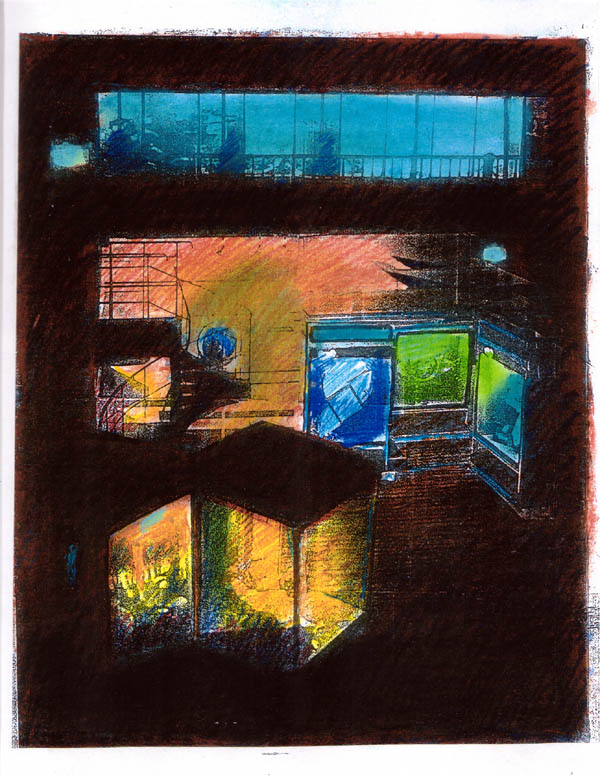
(Charcoal, compressed charcoal and coloured Conte in A4 sketchbook)
The strange environment created by the designers within the old halls of the Hancock Museum, using sheets of MDF, extended to the ceiling. From there hung screens on which occasional videos were projected. They managed to create an otherworldly atmosphere, but failed to convey anything of the contents of the Museum.
South Seas Case (work in progress)
After posting the Ethnographic Case drawing from the Museum Sketchbook, I recently recalled that after I started a painting based on it, I took a photograph; and here it is. Although the painting is tucked away at the back of the studio right now, I think I moved it along a little after taking the photograph and it's possible that I changed the format, taking off the right hand section to leave a square.
I wish I could remember the size of the canvas, because I have some plans to start thinning out large, unfinished work from the studio and I'd be sorry to see this one go.
Hancock: Ethnographic Case
(Charcoal, compressed charcoal across two pages of A4 sketchbook)
On one of the galleries of the Hancock Museum was a set of Ethnographic Cases devoted to artifacts from around the world. This one displayed items from the South Seas: shields, unidentified wooden objects and brightly coloured stuffed birds.
Somewhere in the studio, there's an unfinished painting based on this drawing, but I can't locate it right now.
Hancock: Hall of the Fossil Tree
(Charcoal, compressed charcoal and coloured Conte across two pages of A4 sketchbook)
Although it probably wasn't intentional, the design of the new curved display panels under the somewhat elderly museum lighting system gave a strange otherworldly aspect to the hall where the fossilised tree stood.
Hancock: Relic Case (Charcoal and compressed charcoal across two pages of A4 sketchbook)
More a cabinet of curiosities than a modern presentation of scientifically catalogued archaeology, this glass case is just the sort of collected wonder I loved as a child, so it was a delight to find it still there when I was drawing in my fifties.
Sadly, I'm sure the new version of the museum will have declared this sort of exhibit passé .
Hancock: Moa Legbone
(Compressed charcoal and coloured Conte in A4 sketchbook)
The moa were giant flightless birds in New Zealand and are generally believed to have died out due to over-hunting by Maoris. All that remain are bones like this which hint at what impressively massive birds they must have been.
I really liked the way the bones stood (literally!) in silhouette against the light from the cases in the background.
Hancock Main Hall and Gallery (2) (Mixed media)
Another version of yesterday's image, produced the same way although the colour was applied in a more graphic manner.
Hancock Main Hall and Gallery (Mixed media)
Not exactly a sketch, but it is in the sketchbook. I started this with a monochrome photograph which I'd photocopied on the library copier. Then I worked over it with coloured Conte sticks and finally ran the result through the library colour Xerox machine, tweaking the effects.
Hancock Museum, Bird Gallery
(Charcoal and compressed charcoal in A4 sketchbook)
I loved this eerie part of the Hancock. It always seemed to be deserted, except, of course, for the stuffed birds in their glass cases who sat on their branches and stared down at me.
Hancock Museum, Main Hall 31.10.97
(Charcoal on two pages of A4 sketchbook)
Looking down from one of the galleries, I could work away without being noticed by the punters downstairs. The only problem was that the lighting was so poor up there that it was difficult to see what I was doing.
Fossil Tree (2B pencil over two pages of A4 sketchbook)
In these times of slow progress to who knows where, I think I might return to pages from my sketchbooks. When last I thought about doing so, I couldn't quite decide which of the various sketchbooks I should tackle first, but in view of the recent attention I've given to the Great North Museum:Hancock the obvious is the Museum Sketchbook.
These first two pages from 1997 (my first year at Newcastle University) show one of the newly installed display areas built from MDF, the architect's material of choice. As you can see it had a lot of nicely curved coloured surfaces and umpteen lighting tracks illuminating ..... not a great deal. A lonely fossilised tree takes pride of place.
Tree Form, Devon, August 1996
(Rotring Art Pen and watercolour in A4 sketchbook)
One of my first drawings showing an interest in plant and tree forms, inspired by the work of Graham Sutherland, which continues to the present.
This is last drawing in Sketchbook No.2 and a big jump in time from the previous sketch - 1992 to 1996. I wonder if that means there's a gap to be filled by looking at other sketchbooks. As I've mentioned before, I began to buy sketchbooks faster than I could fill them and to use them for specific subjects.
Watch this space if you're interested. There'll be more to come. There's the Museum Sketchbook, the Saltwell Park Sketchbook, the Malta Sketchbook ......





 Posts
Posts